Sierra Special Education Advocacy
  • Sign In
  • Create Account

  • My Account
  • Signed in as:

  • filler@godaddy.com


  • My Account
  • Sign out

  • Home
  • About SSEA
    • What We Do
    • Meet Bonnie Klein
    • Pricing & Payment Info
  • Where to Start
    • Schedule a Consultation
    • Starting the IEP Process
  • Contact Us
    • Contact Info
    • Schedule a Consultation
  • Is Your IEP Working
  • Resources
    • Client Forms
    • Provider Recommendations
    • Silver State Conf 2026
  • More
    • Home
    • About SSEA
      • What We Do
      • Meet Bonnie Klein
      • Pricing & Payment Info
    • Where to Start
      • Schedule a Consultation
      • Starting the IEP Process
    • Contact Us
      • Contact Info
      • Schedule a Consultation
    • Is Your IEP Working
    • Resources
      • Client Forms
      • Provider Recommendations
      • Silver State Conf 2026
Sierra Special Education Advocacy

Signed in as:

filler@godaddy.com

  • Home
  • About SSEA
    • What We Do
    • Meet Bonnie Klein
    • Pricing & Payment Info
  • Where to Start
    • Schedule a Consultation
    • Starting the IEP Process
  • Contact Us
    • Contact Info
    • Schedule a Consultation
  • Is Your IEP Working
  • Resources
    • Client Forms
    • Provider Recommendations
    • Silver State Conf 2026

Account


  • My Account
  • Sign out


  • Sign In
  • My Account

If you leave a progress report with more questions than answers, 

it may be time to ask for clarification or request an IEP meeting.

What Is Your Child's Progress Report Really Telling You?
Why Progress Reports Matter

Progress reports are more than a routine school document. They are one of the primary ways parents can determine whether an IEP is effective and whether their child is receiving meaningful educational benefit.

What Should a Progress Report Tell You?

A meaningful progress report should do more than summarize how your child is doing. It should help you understand whether your child is making progress toward their IEP goals and whether the current program is effective.

At a minimum, parents should be able to answer three questions after reviewing a progress report:

  1. Where did my child start?
  2. Where is my child now?
  3. Is my child on track to meet the annual goal?

If a progress report doesn't provide enough information to answer these questions, it may be time to ask for additional clarification or data.

RED FLAGS IN PROGRESS REPORTS

🚩The report doesn't include meaningful data

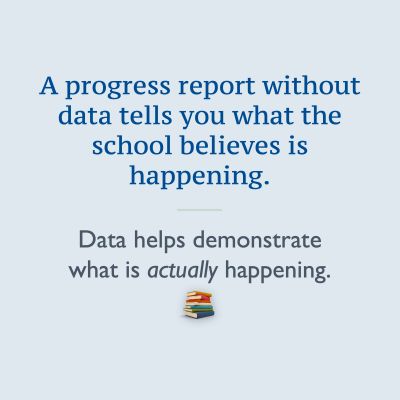
Statements such as "making progress," "improving," or "working toward the goal" are not data. While narrative comments can provide helpful context, they should be supported by measurable information that shows where the student started, where they are now, and whether they are on track to meet the annual goal.

🚩The same comments appear report after report

Progress reports should reflect your child's current performance. When the same comments are repeated quarter after quarter, it may be worth asking whether new data is being collected and whether progress is actually being measured.

🚩The data doesn't show sufficient progress

Not every child progresses at the same rate, but the data should generally show growth over time. If progress is limited despite ongoing services and supports, the IEP team may need to consider whether changes are necessary.

🚩Your child is not on track to meet their annual goals

Progress reports should help answer an important question: Is my child on track to meet this goal by the end of the IEP year? If the answer is no, it may be time to discuss adjustments to instruction, services, supports, or the goal itself.

🚩The report doesn't match what you're seeing

Parents have valuable insight into their child's strengths and challenges. If progress reports tell a very different story than what you observe at home or hear from others who work with your child, don't be afraid to ask questions and request additional information.

🚩Progress reports are missing or inconsistent

Parents should receive progress reports on a regular schedule. Missing, delayed, or inconsistent reporting can make it difficult to understand how your child is doing and participate meaningfully in educational decision-making.

Questions Parents Can Ask

About the Data

  • What specific data was used to determine progress?
  • How frequently is progress being measured?
  • Can I see the data that supports this report?
  • How does current performance compare to the baseline? 
  • What does the trend in the data show over time?

About Progress Toward the Goal

  • Is my child on track to meet this goal by the end of the IEP year?
  • How much progress would you expect to see at this point? 
  • What evidence demonstrates meaningful progress? 
  • If progress continues at the current rate, what outcome do you anticipate?

About Instruction and Services

  • What instructional strategies are being used to teach this skill?
  • Are the current services and supports sufficient to help my child make progress?
  • Has anything changed in how this goal is being addressed since the last progress report?
  • Are there barriers that may be impacting my child's progress?

About Next Steps

  • If my child is not making expected progress, what changes should the IEP team consider?
  • Should this goal, service, accommodation, or support be revised?
  • Would additional assessment or data collection help us better understand my child's needs?
  • Do we need to reconvene the IEP team to discuss concerns?


Need help understanding your child's progress?

SSEA can help! If you need help understanding your child’s progress or want support in communicating with the school about your concerns and requests, SSEA can help.   

Reach Out Today!

I am a non-attorney special education advocate. The information, guidance, and support provided are based on my experience and knowledge of special education practices and procedures. I do not offer legal advice or legal representation. Any information shared should not be interpreted as legal advice. For assistance with legal matters or interpretation of the law, please consult with a licensed attorney.

Copyright © 2026 Sierra Special Education Advocacy - All Rights Reserved.


Powered by

This website uses cookies.

We use cookies to analyze website traffic and optimize your website experience. By accepting our use of cookies, your data will be aggregated with all other user data.

Accept